
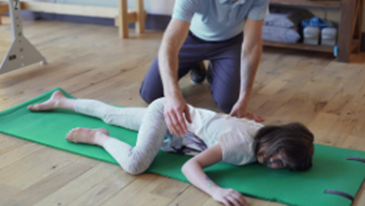
The process begins with an initial assessment. In this first session, the practitioner will gently evaluate your child’s developmental reflexes, balance, coordination, and other foundation skills. Don’t worry – this evaluation is fun and low-stress for the child. It might feel like simple play or exercises, and it helps us identify which reflexes are retained or which skills need support. Based on this assessment, we create a customized programme of exercises for your child.
After the assessment, you will be given a home programme of short daily exercises to do with your child. Typically, your child will need to do 1–3 specific exercises each day, which usually take about 5–10 minutes in total. These activities are straightforward and age-appropriate – often things like gentle stretching or movement games that can be done at home without any special equipment. We make sure to teach you each exercise so you feel comfortable doing them. Many families fit these exercises into their routine (for example, before dinner or at bedtime). Consistency is key: doing a few minutes every day is far more effective than a longer session once in a while. The good news is that kids often begin to enjoy the routine, especially as they start to feel the benefits… and they enjoy your full attention!
Throughout the programme, there will be regular follow-up sessions at the clinic. Typically, we schedule follow-ups about every 4–6 weeks (this can vary depending on your child’s needs and your schedule). At a follow-up visit, we will check your child’s progress – re-testing some reflexes or skills – and then introduce new exercises or adjust the programme as needed. These appointments are also a great time for you to discuss any questions or observations with the practitioner. Each follow-up is usually a positive experience as we often get to celebrate improvements (big or small) and keep your child motivated. Between follow-ups, we are available if you have any concerns or need guidance. In short, the programme involves an ongoing partnership: the practitioner provides expert guidance and programme adjustments, and the family carries out the daily exercises at home. This team approach ensures your child gets the best possible outcome in a supportive environment.
How long does the programme usually last?
Every child’s timeline is a bit different, but on average we ask families to commit to about 14 months of active participation in the programme. In many cases, the core of the Neuro-Developmental Therapy programme can be completed in roughly a year to 18 months. Some children with milder difficulties may finish sooner, and others with more complex needs might continue a bit longer – we tailor the length to each child’s progress. This may sound like a long time, but remember that we are creating fundamental, lasting changes in the brain’s wiring; that process naturally happens gradually. Think of it like strengthening the foundation of a house – it’s not an overnight fix, but the result is solid and enduring.
It’s important to set realistic expectations: this therapy is not a quick one-time intervention, but rather a developmental journey. We want to give the brain ample time to develop new connections and for your child to practice and solidify new skills. The good news is that you will not be working blindly for a year without seeing anything change. Typically, we will observe small positive changes along the way, sometimes after the first couple of months. Those little victories – perhaps better balance, neater handwriting, or improved eye contact – encourage us that the foundation is strengthening. Even after the formal programme ends, many families continue to do occasional exercises or activities to reinforce progress (much like you keep brushing your teeth every day even after the dentist fixes a cavity!). Overall, you should be prepared for roughly a year of consistent work, with the understanding that this timeframe can be adjusted as we monitor your child’s individual growth.
When will we start to see changes or improvements?
Most parents are eager to know when they might notice differences in their child. While every child is unique, many families report seeing initial subtle improvements within the first 2-3 months of consistent daily exercises. These early changes might be small – for example, your child might start sitting still a bit longer during homework, show less frustration during handwriting practice, or have an easier time catching a ball. Such signs indicate that their neurological development is moving in the right direction.
As the programme continues, these improvements tend to accumulate and become more noticeable. Typically, by the halfway point (around 6 months in), parents often see more substantial changes – perhaps your child is reading with greater ease, showing better coordination on the playground, or handling sensory distractions (like loud noises or scratchy clothes) with less upset. It’s important to remember that progress is gradual and varies for each child. Some children may have a quick burst of progress early on, while others improve steadily at a slower pace. Both patterns are normal. The key is consistent practice and patience. We will be checking in regularly, so if progress ever seems stalled, we can adjust the approach to get things moving again. By the end of the programme (around 12 months or more), many parents are amazed at how far their child has come. In summary, you can expect to see small changes after a few weeks to months, with more obvious improvements usually becoming clear over several months of therapy. We will celebrate those victories with you as they come!


